


In Memoriam:
Ben Nighthorse Campbell
(1933 - 2025)
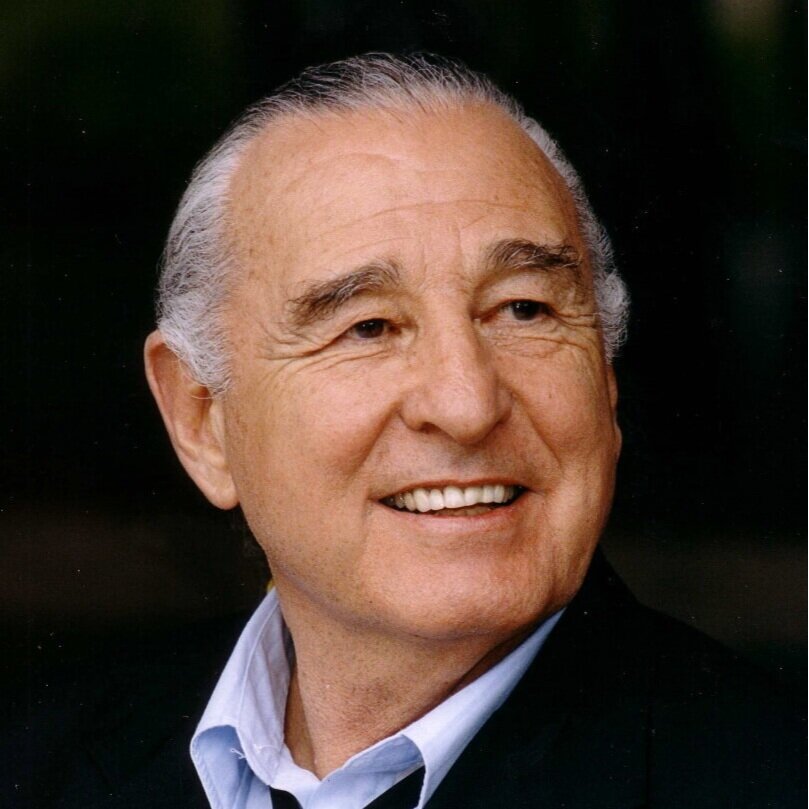
In 1998, against the odds, the only Native American U.S. Congressman, Ben Nighthorse Campbell, courageously introduced legislation to establish the Sand Creek Massacre National Historic Site. Amidst considerable controversy, the site would commemorate an early morning surprise attack by the United States Army on a peaceful Cheyenne and Arapaho village. Led by Col. John M. Chivington, a Methodist minister, the 1864 Sand Creek Massacre took the lives of nearly 230 innocent Cheyenne and Arapaho people, mostly women, children, and the elderly. Senator Campbell’s Cheyenne ancestors were among the survivors. Through the perseverance of Cheyenne and Arapaho descendants and the Senator’s outspoken leadership in Congress, the Sand Creek Massacre National Historic Site was passed into law in 2000 and established in 2007. Although he had just recently retired as a U.S. Senator, Nighthorse Campbell helped to preside over the ceremony dedicating the national historic site as the 391st unit of the National Park Service.
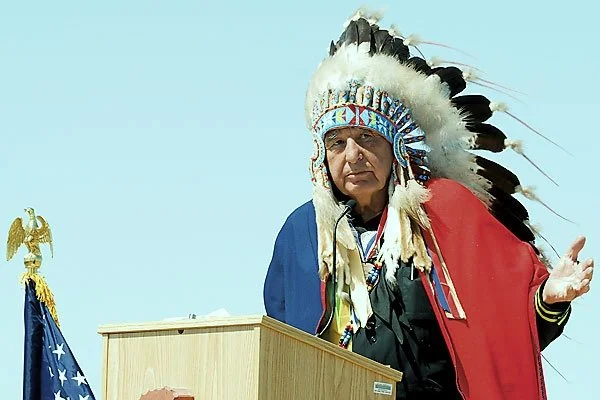
Senator Ben Nighthorse Campbell addressing the dedication of the Sand Creek Massacre National Historic Site on June 1st, 2007.
Today, the site remains as the only national historic site named for a massacre of Native people by the U.S. military. Due to Senator Campbell’s leadership, Cheyenne and Arapaho descendents broke through more than a century of denial by bringing the massacre’s story back into the consciousness of the federal government and the American public. During this time, Senator Campbell proceeded with noted humbleness and desire to work on behalf of Native people. He put his ancestry and people first. His ‘being’ was all about genuine access to the true story of American and Native history. The passage of his legislation in 1998 and 2000 was monumental in its acknowledgement of an extremely traumatic period for the Plains Indian tribes. Senator Campbell’s commitment not only paved the way for the Cheyenne people and the Arapaho people to gain a sense of healing, but for all who inherited the legacy of the Sand Creek Massacre, including descendants of Territorial Governor John Evans, the United Methodist Church, members and descendants of the U.S. military, the Kiowa County community, and the State of Colorado.
Senator Campbell’s commitment to elevating Native history and culture where previously omitted extended far beyond Sand Creek. He was integral in the creation of the Indian Memorial at Little Bighorn National Monument in 2003, and supported the development of the National Museum of the American Indian, the final Smithsonian museum to be constructed on the mall in Washington, DC, in 2004. His support for Native causes also led him to serve as Chairman of the Senate Indian Affairs Committee and as a member of the Senate Appropriations Committee. Never seeking the spotlight in these roles, he secured support and funding to improve the health and welfare conditions for Native People in such a way that he will be forever remembered as a leader on Indian Health issues who rarely got credit for what he did.
In 2020, Ben Nighthorse Campbell helped to found the non-profit Sand Creek Massacre Foundation and served as its Honorary Chairman of the Board until his passing on December 31st, 2025. It is with profound gratitude and deep respect that the Sand Creek Massacre Foundation continues to honor and build upon the legacy that Senator Ben Nighthorse Campbell leaves for the American people, past, present and future.